Mammalia |
Cetartiodactyla |
Delphinidae
Miljö: miljö / Klimatzon / djupintervall / distributionsområde
Ekologi
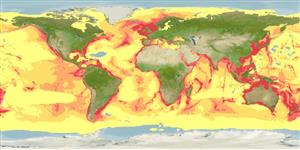
Pelagiska; havsvandrande (Ref. 75906); djupintervall 0 - 1316 m (Ref. 116169). Tropical
208994 Tursiops truncatus gephyreus. Southwest Atlantic.
Längd vid första mognad / Storlek / Vikt / Ålder
Könsmognad: Lm ?, range 240 - 260 cm Max length : 380 cm TL hane/ej könsbestämd; (Ref. 1394); publicerad maxvikt: 650.0 kg (Ref. 1394)
This coastal subspecies (Tursiops truncatus geyphyreus) can be distinguished from the nominate offshore subspecies (Tursiops truncatus truncatus) by the following diagnosable cranial features: W-shaped border of the antorbital notch (vs. U-shaped); barely or not visible interparietal bone (vs. clearly visible); cranial vertex from the posterior end of nasals to the nuchal crest is short and rectangular (vs. long and squared); left nasal bone noticeably smaller and more compressed antero-posteriorly than the right (vs. nearly symmetrical); Falciform lateral margin of the ascending process of right premaxilla (vs. straight or slightly concave); lateral margin of the ascending process of the maxillae over the preorbital process is deflected dorsally (vs. flat) (Ref. 128824).
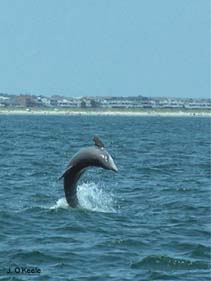
Preyed upon by great white sharks (Ref. 32140). Dolphins are directly caught for use as shark-bait in Sta. Ana and Aparri, Philippines (Ref. 77119). Found primarily in coastal and inshore regions of tropical and temperate waters of the world (Ref. 936) and deeper channels between islands (Ref. 122680). Also inhabits pelagic waters, such as those in the eastern tropical Pacific (Ref. 936). In herds of less than 20 individuals (Ref. 801). Feeds either cooperatively or in solitary. They can obtain prey via 'fish whacking' and steering fish onto mudflats (Ref. 122680). Feeds on fish (Refs. 801, 936) crustaceans, and cephalopods (Ref. 801).
Livscykel och parningsbeteende
Könsmognad | Reproduktion | Lek | Ägg | Fekunditet | Larver
Tan, J.M.L. 1995 A Field Guide to the Whales and Dolphins in the Philippines. Makati City: Bookmark. 125 p. (Ref. 936)
CITES-status (Ref. 108899)
Hot mot människor
Mänskliga användningsområden
Fiskeri: kommersiell; bete: usually
FAO - fiskeri: landningar, artprofil | FishSource |
Verktyg
Ytterligare information
Trofisk ekologiLivsmedelsartiklar (preys)
Födosammansättning
Födointag
Predatorer
PopulationsdynamikTillväxtMax. åldrar / storlekarLängd-vikt rel.Längd-längd rel.Längd-frekvenserMassakonverteringAbundans LivscykelReproduktion
Könsmognad
Fekunditet
Lek
Ägg
Utveckling av ägg
Larver
MänniskorelateradFrimärken, mynt, diverse.
Internet-källor
Uppskattningar baserade på modeller
Önskad temperatur
(Ref.
115969): 6.4 - 28.9, mean 20.3 (based on 16698 cells).
Sårbarhet i fisket
Very high vulnerability (76 of 100).
Priskategori
Unknown.