Gastropoda |
Neogastropoda |
Muricidae
Milieu: milieu / Klimaatzone / Diepte / verspreidingsgebied
Ecologie
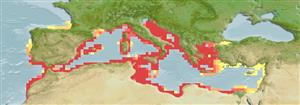
Benthic; diepte 1 - 200 m (Ref. 105998). Subtropical, preferred 20°C (Ref. 107945); 45°N - 30°N, 10°W - 36°E
Eastern Atlantic and the Mediterranean: from Portugal to central Morocco in the Atlantic, and east to Lebanon. Introduced in Atlantic Spain.
Lengte bij maturiteit / Grootte / Gewicht / Leeftijd
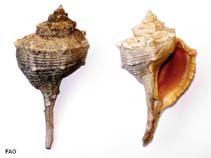
Maturiteit: Lm 5.6, range 4 - ? cm Max length : 10.8 cm ShL mannelijk / geslacht onbekend; (Ref. 127250); max. gepubliceerd gewicht: 79.70 g (Ref. 127250)
Has high economic value since ancient times because it is used to produce a purple dye (Refs. 78459, 78460 and 78461). Carnivorous and feeds on bivalves and other gastropods (Ref. 2532).
Showed an annual reproductive cycle in the Catalan coast. The reproductive cycle had two peaks (April and June -July) but the first one seems to be less important because the number of immature females is higher than the mature ones.
Museum of Natural History in Paris 2005 CLEMAM - Checklist of European Marine Mollusca - Public scientific database, consulted on [020606], hosted by Muséum National d'Histoire Naturelle (M.N.H.N.), Paris, at: http://www.mnhn.fr/biotaxis/clemam. Muséum National d'Histoire Naturelle (M.N.H.N.), Paris, at: http://www.mnhn.fr/biotaxis/clemam (Ref. 1056)
Status op de Rode Lijst van het IUCN
(Ref. 130435: Version 2025-2 (Global))
CITES status (Ref. 108899)
Not Evaluated
Not Evaluated
Gevaar voor de mens
Gebruik door de mens
Visserij: commercieel
| FishSource | Sea Around Us
Tools
Meer informatie
FysiologieZuurstofverbruik
Internetbronnen
Schattingen op basis van modellen
Gewenste temperatuur
(Ref.
115969): 16.2 - 21.6, mean 19.3 (based on 132 cells).
Prior r = 1.01, 95% CL = 0.67 - 1.52, Based on 2 full stock assessments.
Kwetsbaarheid van de visserij
Low vulnerability (10 of 100).
Kwetsbaarheid voor het klimaat
Very high vulnerability (77 of 100).
Prijsklasse
Unknown.
Nutrients : Calcium = 126 [75, 177] mg/100g; Iron = 4.79 [1.67, 7.92] mg/100g; Protein = 15.9 [14.8, 16.9] %; Omega3 = 0.331 [0.263, 0.400] g/100g; Selenium = 57.8 [48.5, 67.2] μg/100g; VitaminA = 0 μg/100g; Zinc = 1.97 [0.92, 3.02] mg/100g (wet weight); based on
nutrient studies.