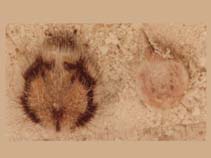
Echinoidea |
Spatangoida |
Loveniidae
Miljö: miljö / Klimatzon / djupintervall / distributionsområde
Ekologi
Benthic; brackvatten; djupintervall 0 - 230 m (Ref. 85345). Subtropical; 72°N - 41°S, 32°W - 179°E
Indo-West Pacific, Atlantic Ocean and the Mediterranean.
Längd vid första mognad / Storlek / Vikt / Ålder
Könsmognad: Lm ? range ? - ? cm Max length : 6.0 cm WD hane/ej könsbestämd; (Ref. 7882)
Species' maximum size from the North Sea off Belgium (Ref. 7882). Found in sandbanks (Ref. 96352) and along the coastal zone. Buries in a wide range of sediment types but often in coarser-grained sediment with low mud content of less than 20% (Ref. 7882). Reported in areas influenced by estuarine outflows (Ref. 96507). Herbivorous epistratum (sub-surface deposit) feeder (Refs. 96352, 96501).
Livscykel och parningsbeteende
Könsmognad | Reproduktion | Lek | Ägg | Fekunditet | Larver
Members of the class Echinoidea are gonochoric. Fertilization is external. Brooding is common, eggs are held either on the peristome, around the periproct or deep into the concavities on the petaloids. Life cycle: Embryos develop into planktotrophic larvae (echinoplateus) and live for several months before they sink to the bottom using their tube feet to adhere on the ground where they metamorphose into young urchins.
Gaspar, M.B., M.N. Santos, F. Leitão, L. Chícharo, A. Chícharo and C.C. Monteiro 2003 Recovery of substrates and macro-benthos after fishing trials with a new Portuguese clam dredge. J. Mar. Biol. Ass. U.K. 83:713-717. (Ref. 2703)
Status på IUCN:s rödlista
(Ref. 130435: Version 2025-2 (Global))
CITES-status (Ref. 108899)
Not Evaluated
Not Evaluated
Hot mot människor
Mänskliga användningsområden
Fiskeri: kommersiell
| FishSource |
Verktyg
Ytterligare information
LivscykelReproduktionKönsmognadFekunditetLekÄggUtveckling av äggLarver MänniskorelateradFrimärken, mynt, diverse.
Internet-källor
Uppskattningar baserade på modeller
Önskad temperatur
(Ref.
115969): 7 - 14.4, mean 9.8 (based on 654 cells).
Sårbarhet i fisket
Low vulnerability (10 of 100).
Priskategori
Unknown.