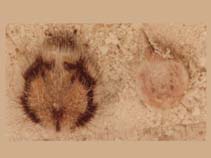
Echinoidea |
Spatangoida |
Loveniidae
環境:環境 / 気候帯 / 深さの範囲 / 分布範囲
生態学
Benthic; 汽水性の; 深さの範囲 0 - 230 m (参照 85345). Subtropical; 72°N - 41°S, 32°W - 179°E
Indo-West Pacific, Atlantic Ocean and the Mediterranean.
初回成熟時の長さ / サイズ / 重さ / 年齢
成熟: Lm ? range ? - ? cm Max length : 6.0 cm WD オス/雌雄の選別がない; (参照 7882)
Species' maximum size from the North Sea off Belgium (Ref. 7882). Found in sandbanks (Ref. 96352) and along the coastal zone. Buries in a wide range of sediment types but often in coarser-grained sediment with low mud content of less than 20% (Ref. 7882). Reported in areas influenced by estuarine outflows (Ref. 96507). Herbivorous epistratum (sub-surface deposit) feeder (Refs. 96352, 96501).
ライフサイクルと交尾行動
成熟 | 繁殖 | 放精 | 卵 | 生産力 | 幼生
Members of the class Echinoidea are gonochoric. Fertilization is external. Brooding is common, eggs are held either on the peristome, around the periproct or deep into the concavities on the petaloids. Life cycle: Embryos develop into planktotrophic larvae (echinoplateus) and live for several months before they sink to the bottom using their tube feet to adhere on the ground where they metamorphose into young urchins.
主な参考文献
参考文献 | コーディネーター | 協力者
Gaspar, M.B., M.N. Santos, F. Leitão, L. Chícharo, A. Chícharo and C.C. Monteiro 2003 Recovery of substrates and macro-benthos after fishing trials with a new Portuguese clam dredge. J. Mar. Biol. Ass. U.K. 83:713-717. (参照 2703)
IUCNのレッドリストの状況は
(参照 130435: Version 2025-2 (Global))
ワシントン条約ステータス (参照 108899)
Not Evaluated
Not Evaluated
人間に対する脅威
人間の用途
水産業: 商業
| FishSource |
用具
インターネットの情報源
モデルに基づく推定値
好ましい温度
(Ref.
115969): 7 - 14.4, mean 9.8 (based on 654 cells).
漁業の脆弱性
Low vulnerability (10 of 100).
価格帯
Unknown.