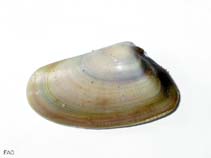
Bivalvia |
Cardiida |
Donacidae
Environnement : milieu / zone climatique / profondeur / gamme de distribution
Écologie
Benthic; profondeur 0 - 25 m (Réf. 2758). Temperate; 61°N - 12°N, 18°W - 44°E (Réf. 78075)
Eastern Atlantic, the Mediterranean, Black Sea and Red Sea.
Longueur à la première maturité / Taille / Poids / Âge
Maturité: Lm 1.8 range ? - ? cm Max length : 4.4 cm SHL mâle / non sexé; (Réf. 2758); common length : 2.0 cm SHL mâle / non sexé; (Réf. 437)
Depth based on occurrence (Ref. 2758, p. 805); to be replaced with better reference. Minimum depth from Ref. 80266. Vital constituent of infra-littoral benthic fauna of sandy beaches. Preferrentially distributed at depths of 0 to 2 m. (Ref. 122884). Subtidal (Ref. 437), living in fine well sorted clean sand (Ref. 2780). Also found in estuaries (Ref. 122883). An exclusive species of the Superficial Fine Sand (SFS) biocoenosis as it's strictly dependent on the sediment’s nature and composition. Rapid and efficient burrower (Ref. 122884).
Cycle de vie et comportement reproducteur
Maturité | Reproduction | Frai | Œufs | Fécondité | Larves
Gonochoric.
Fischer, W., G. Bianchi and W.B. Scott (eds.) 1981 Bivalves. 6: pag.var. In FAO species identification sheets for fishery purposes. Eastern Central Atlantic (fishing areas 34, 47; in part). Canada Funds-in-Trust. Ottawa, Department of Fisheries and Oceans Canada, by arrangement with the Food and AgriculturesOrganization of the United Nations, 1-7: pag.var. (Réf. 437)
Statut dans la liste rouge de l'IUCN
(Réf. 130435: Version 2025-2 (Global))
statut CITES (Réf. 108899)
Not Evaluated
Not Evaluated
Menace pour l'homme
Utilisations par l'homme
Pêcheries: commercial
| FishSource |
Outils
Plus d'informations
Écologie trophiqueAliments (proies)
Composition du régime alimentaire
Consommation alimentaire
Prédateurs
Dynamique des populations PhysiologieConsommation d'oxygène
Liées à l'hommeTimbres, pièces de monnaie, divers
Sources Internet
Estimations basées sur des modèles
Température préférée
(Ref.
115969): 12.4 - 21.6, mean 19 (based on 746 cells).
Résilience
Haut, temps minimum de doublement de population inférieur à 15 mois (K=0.3-1.93).
Vulnérabilité de la pêche
Low vulnerability (15 of 100).