Cephalopoda |
Oegopsida |
Octopoteuthidae
Umwelt: Milieu / Klimazone / Tiefenbereich / Verbreitungsgebiet
Ökologie
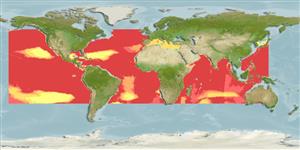
Pelagic-oceanic; tiefenbereich 385 - 395 m (Ref. 97142). Tropical; 55°N - 34°S, 170°W - 142°E (Ref. 275)
Circumglobal, mainly found in tropical and subtropical waters but is also found in boreal and notalian waters (Ref. 7575).
Länge bei der ersten Reifung / Größe / Gewicht / Alter
Geschlechtsreife: Lm ? range ? - ? cm Max length : 170 cm ML Männchen/unbestimmt; (Ref. 97142); max. veröff. Gewicht: 64.4 kg (Ref. 97142)
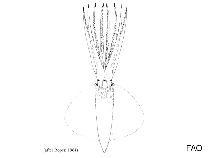
Oceanic (Refs. 1983, 97142). Mesopelagic (Ref. 77090). Paralarvae and juveniles are epipelagic to upper mesopelagic, then undergo ontogenetic descent into the lower mesopelagic, bathypelagic and bathyal zones. Adults undergo diel vertical migration and ascend into the epipelagic zone at night. Juveniles have been captured at night within 175 m from the surface, while the remains of a large specimen (50 kg) were taken from the stomach of the bottom-living shark, Centroscymnus coelolepis, caught on a bottom-set longline at 1,246 m. A mature female of 1.4 m mantle length had 250,000 ovarian eggs. Observations on bioluminescence from living animals verified a rapid flash response from the arm tip photophores, as a startling or warning function, and a steady glow from the visceral photophores as is common for protective counter illumination. In situ video footage reveals it to be a strong swimmer, both forward and backward, propelled by its huge fins, and changes directions quickly by bending its body. Observed attack on a bait rig showed speeds of 7.2 to 9 km/h and emission of short, bright flashes from its 2 arm-tip photophores before it attacked. It also emits long and short intermittent glows when swimming around the lighted bait rig. Preyed upon by many species of pelagic fishes, including lancetfish (Aleposauris ferox), tunas, swordfish (Xiphias gladius), hammerhead, tiger and blue sharks, as well as odontocete cetaceans: short-finned pilot whale and most especially, sperm whales in all oceans (Ref. 97142).
Lebenszyklus und Paarungsverhalten
Geschlechtsreife | Fortpflanzung | Ablaichen | Eier | Fruchtbarkeit | Larven
Members of the class Cephalopoda are gonochoric. Male and female adults usually die shortly after spawning and brooding, respectively. Mating behavior: Males perform various displays to attract potential females for copulation. During copulation, male grasp the female and inserts the hectocotylus into the female's mantle cavity where fertilization usually occurs. Life cycle: Embryos hatch into planktonic stage and live for some time before they grow larger and take up a benthic existence as adults.
Roper, C.F.E., M.J. Sweeney and C.E. Nauen 1984 FAO Species Catalogue. Vol. 3. Cephalopods of the world. An annotated and illustrated catalogue of species of interest to fisheries. FAO Fish. Synop. 125(3):277p. Rome: FAO. (Ref. 275)
IUCN Rote Liste Status
(Ref. 130435: Version 2025-2 (Global))
CITES Status (Ref. 108899)
Not Evaluated
Not Evaluated
Bedrohung für Menschen
Nutzung durch Menschen
Fischereien: kommerzielles potential
| FishSource |
Tools
Mehr Information
PopulationsdynamikWachstumMax. Alter/GrößenLänge-Gewicht-Rel.Länge-Länge-Verhältnis.LängenhäufigkeitenMassenkonvertierungDichte LebenszyklusFortpflanzungGeschlechtsreifeFruchtbarkeitAblaichenEierEientwicklungLarven PhysiologieSauerstoffverbrauch
MenschenbezogenBriefmarken, Münzen, Verschiedenes.
Internet Quellen
Schätzungen auf der Grundlage von Modellen
Bevorzugte Temperatur
(Ref.
115969): 8.2 - 13.7, mean 10 (based on 18 cells).
Anfälligkeit der Fischerei
Very high vulnerability (90 of 100).