Demospongiae |
Suberitida |
Halichondriidae
Environnement : milieu / zone climatique / profondeur / gamme de distribution
Écologie
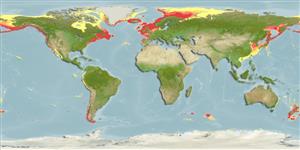
Sessile; profondeur 0 - 534 m (Réf. 119523). Temperate; 85°N - 80°S, 180°W - 180°E
Northern Pacific, Northern Atlantic, Antarctic and the Arctic.
Longueur à la première maturité / Taille / Poids / Âge
Maturité: Lm ? range ? - ? cm Max length : 60.0 cm WD mâle / non sexé; (Réf. 865)
Filters small suspended particles, which includes free bacteria and colloidal organic matter (Ref. 96471). Trophic level 1.7-2.3 (Ref. 96418). Part of the fouling communities attached to raft frames in mariculture zones (Ref. 127121).
Cycle de vie et comportement reproducteur
Maturité | Reproduction | Frai | Œufs | Fécondité | Larves
Members of the class Demospongiae are hermaphroditic. Life cycle: The zygote develops into parenchymella larva (free-swimming) before settling down on a substrate where it grows into a young sponge.
Harms, J. 1993 Check list of species (algae, invertebrates and vertebrates) found in the vicinity of the island of Helgoland (North Sea, German Bight) - a review of recent records. Helgoländer Meeresunters 47:1-34. (Réf. 2711)
Statut dans la liste rouge de l'IUCN
(Réf. 130435: Version 2025-2 (Global))
statut CITES (Réf. 108899)
Not Evaluated
Not Evaluated
Menace pour l'homme
Utilisations par l'homme
| FishSource |
Outils
Plus d'informations
Écologie trophiqueAliments (proies)Composition du régime alimentaireConsommation alimentairePrédateurs Dynamique des populationsCroissance
Âges / tailles maximales
Longueur-poids rel.
Rel. longueur-longueur.
Fréquences de longueurs
Conversion de masse
Abondance
Cycle de vieReproductionMaturitéFéconditéFraiŒufsDéveloppement de l'œufLarves PhysiologieConsommation d'oxygène
Liées à l'hommeTimbres, pièces de monnaie, divers
Sources Internet
Estimations basées sur des modèles
Température préférée
(Ref.
115969): 2.1 - 25, mean 9.7 (based on 2098 cells).
Vulnérabilité de la pêche
Moderate vulnerability (44 of 100).
Catégorie de prix
Unknown.