Demospongiae |
Dictyoceratida |
Spongiidae
Umwelt: Milieu / Klimazone / Tiefenbereich / Verbreitungsgebiet
Ökologie
Sessile; tiefenbereich 5 - 76 m (Ref. 363), usually 5 - 40 m (Ref. 363). Subtropical; 46° - 25°
Mediterranean. Reports from the Indo-West Pacific, Caribbean must checked.
Länge bei der ersten Reifung / Größe / Gewicht / Alter
Geschlechtsreife: Lm ? range ? - ? cm
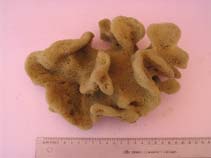
Sponge: variable; generally massive; round, but being able equipped with regular lobes (especially at the large specimens); or with large conical lobes osculus. Surface equipped with many small conules regular. Osculus: 0.3 to 1 cm in diameter; often raised. Primary fibers: 0.005 to 0.01 cm diameter; very few formed at their end in the conules by the anastomoses of several fibers; and containing some foreign bodies. The secondary fibers: 0.002 with 0.0035 cm of diameter; in tightened network sometimes finest close to surface. Coloring: color varying of the a little yellowish white to the black according to illumination, whitish with color of rust inside
Maximum size: Can exceed 35 cm in diameter. Depth: common between 5 m (under the overhangs) and 40 m; rare between 40 and 76 m. Importance: The fine sponge; used especially for the toilet, is exploited mainly in Greece, but with a weak production (Ref. 363). Found in the littoral areas particularly coral reefs with rock substrates (Ref. 82063). Common between 5 m (under the overhangs) and 40 m; rare between 40 and 76 m (Ref. 363). Filter-feeder (Ref. 68823).
Lebenszyklus und Paarungsverhalten
Geschlechtsreife | Fortpflanzung | Ablaichen | Eier | Fruchtbarkeit | Larven
Members of the class Demospongiae are hermaphroditic. Life cycle: The zygote develops into parenchymella larva (free-swimming) before settling down on a substrate where it grows into a young sponge.
Vacelet, J. 1987 Éponges. p. 137-148. In Fischer, W., M. L. Bauchot and M. Schneider. 1987. Fiches FAO d' identification des espèces pour les besoins de la pêche. (Revision 1). Méditerranée et mer Noire. Zone de pêche 37. Volume I. Végëtaux et Invertébrés. Publication préparée par la FAO, résultant d'un accord entre la FAO et la Commission des Communautés européennes (Project GCP/INT/422/EEC) financëe conjointement par ces deux organisations. Rome, FAO, Vol.1. (Ref. 363)
IUCN Rote Liste Status
(Ref. 130435: Version 2025-2 (Global))
CITES Status (Ref. 108899)
Not Evaluated
Not Evaluated
Bedrohung für Menschen
Nutzung durch Menschen
Fischereien: hoch kommerziell
| FishSource |
Tools
Mehr Information
Trophische ÖkologieLebensmittel (Beutetiere)
Nahrungszusammensetzung
Nahrungsaufnahme
Räuber
PopulationsdynamikWachstumMax. Alter/GrößenLänge-Gewicht-Rel.Länge-Länge-Verhältnis.LängenhäufigkeitenMassenkonvertierungDichte LebenszyklusFortpflanzungGeschlechtsreifeFruchtbarkeitAblaichenEierEientwicklungLarven PhysiologieSauerstoffverbrauch
MenschenbezogenBriefmarken, Münzen, Verschiedenes.
Internet Quellen
Schätzungen auf der Grundlage von Modellen
Bevorzugte Temperatur
(Ref.
115969): 16.2 - 28.4, mean 25.4 (based on 1548 cells).
Preiskategorie
Unknown.