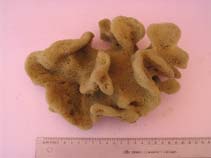
Demospongiae |
Dictyoceratida |
Spongiidae
البيئة: الوسط / المنطقة المناخية / نطاق العمق / نطاق التوزيع
البيئة
Sessile; نطاق العمق 5 - 76 m (مرجع 363), usually 5 - 40 m (مرجع 363). Subtropical; 46° - 25°
Mediterranean. Reports from the Indo-West Pacific, Caribbean must checked.
الطول عند النضج الأول / الحجم / وزن / العمر
النضج: Lm ? range ? - ? cm
Sponge: variable; generally massive; round, but being able equipped with regular lobes (especially at the large specimens); or with large conical lobes osculus. Surface equipped with many small conules regular. Osculus: 0.3 to 1 cm in diameter; often raised. Primary fibers: 0.005 to 0.01 cm diameter; very few formed at their end in the conules by the anastomoses of several fibers; and containing some foreign bodies. The secondary fibers: 0.002 with 0.0035 cm of diameter; in tightened network sometimes finest close to surface. Coloring: color varying of the a little yellowish white to the black according to illumination, whitish with color of rust inside
Maximum size: Can exceed 35 cm in diameter. Depth: common between 5 m (under the overhangs) and 40 m; rare between 40 and 76 m. Importance: The fine sponge; used especially for the toilet, is exploited mainly in Greece, but with a weak production (Ref. 363). Found in the littoral areas particularly coral reefs with rock substrates (Ref. 82063). Common between 5 m (under the overhangs) and 40 m; rare between 40 and 76 m (Ref. 363). Filter-feeder (Ref. 68823).
دورة الحياة وسلوك التزاوج
النضج | التكاثر | وضع البيض | بيض | الخصوبة | اليرقات
Members of the class Demospongiae are hermaphroditic. Life cycle: The zygote develops into parenchymella larva (free-swimming) before settling down on a substrate where it grows into a young sponge.
Vacelet, J. 1987 Éponges. p. 137-148. In Fischer, W., M. L. Bauchot and M. Schneider. 1987. Fiches FAO d' identification des espèces pour les besoins de la pêche. (Revision 1). Méditerranée et mer Noire. Zone de pêche 37. Volume I. Végëtaux et Invertébrés. Publication préparée par la FAO, résultant d'un accord entre la FAO et la Commission des Communautés européennes (Project GCP/INT/422/EEC) financëe conjointement par ces deux organisations. Rome, FAO, Vol.1. (مرجع 363)
حالة القائمة الحمراء للاتحاد الدولي لحفظ الطبيعة والموارد الطبيعية
(مرجع 130435: Version 2025-2 (Global))
حالته حسب اتفاقية سايتس (مرجع 108899)
Not Evaluated
Not Evaluated
خطر للأنسان
استخدامات بشرية
مصائد: ذو قيمة تاجرية عالية
| FishSource |
أدوات
مزيد من المعلومات
علم البيئة الغذائيةالمواد الغذائية (الفرائس)
التركيبة الغذائية
استهلاك الأغذية
مفتريسات
دورة الحياةالتكاثرالنضجالخصوبةوضع البيضبيضتطور البيضةاليرقات علم وظائف الأعضاءاستهلاك الأوكسجين
ذات الصلة بالبشرطوابع بريدية وعملات معدنية ومتنوعة
مصادر علي الأنترنت
تقديرات تستند إلى النماذج
درجة الحرارة المفضلة
(Ref.
115969): 16.2 - 28.4, mean 25.4 (based on 1548 cells).
فئة السعر
Unknown.