Bivalvia |
Adapedonta |
Pharidae
Milieu: milieu / Klimaatzone / Diepte / verspreidingsgebied
Ecologie
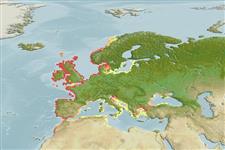
Benthic; brak water; diepte 3 - 14 m (Ref. 113231), usually 3 - 7 m (Ref. 105455). Subtropical; 69°N - 30°N, 11°W - 36°E
Northeast Atlantic and the Mediterranean: from Norwegian Sea and the Baltic, south to the Iberian Peninsula, into the Mediterranean, and along the Atlantic coast of Morocco.
Lengte bij maturiteit / Grootte / Gewicht / Leeftijd
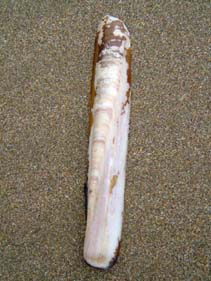
Maturiteit: Lm ? range ? - ? cm Max length : 15.5 cm SHL mannelijk / geslacht onbekend; (Ref. 2758)
Minimum depth from Ref. 105455. It is a sessile-burrower, suspension feeder (Ref. 96498). Occurs in fine sand (Ref. 105213). In general, suspension feeding bivalves mainly depend on phytoplankton and detritus material for nutrition (Ref. 107088).
Levenscyclus en paargedrag
Maturiteit | Voortplanting | Paaien | Eieren | Fecunditeit | Larven
Members of the class Bivalvia are mostly gonochoric, some are protandric hermaphrodites. Life cycle: Embryos develop into free-swimming trocophore larvae, succeeded by the bivalve veliger, resembling a miniature clam.
Tuck, I.D., N. Bailey, M. Harding, G. Sangster, T. Howell, N. Graham and M. Breen 2000 The impact of water jet dredging for razor clams, Ensis spp., in a shallow sandy subtidal environment. Journal of Sea Research 43:65-81. (Ref. 2699)
Status op de Rode Lijst van het IUCN
(Ref. 130435: Version 2025-2 (Global))
CITES status (Ref. 108899)
Not Evaluated
Not Evaluated
Gevaar voor de mens
Gebruik door de mens
Visserij: commercieel
| FishSource | Sea Around Us
Tools
Meer informatie
LevenscyclusVoortplantingMaturiteitFecunditeitPaaienEierenOntwikkeling van de eierenLarven FysiologieZuurstofverbruik
Menselijk gerelateerdPostzegels, munten, diversen.
Internetbronnen
Schattingen op basis van modellen
Gewenste temperatuur
(Ref.
115969): 9 - 18.8, mean 11.4 (based on 555 cells).
Weerstandsvermogen
Hoog, minimale populatieverdubbelingstijd minder dan 15 maanden (K=0.7).
Kwetsbaarheid van de visserij
Low vulnerability (16 of 100).
Prijsklasse
Unknown.
Nutrients : Calcium = 149 [71, 228] mg/100g; Iron = 8.53 [1.95, 15.11] mg/100g; Protein = 9.88 [8.64, 11.12] %; Omega3 = 0.313 [0.202, 0.423] g/100g; Selenium = 61 [50, 72] μg/100g; VitaminA = 0 μg/100g; Zinc = 2.04 [0.56, 3.51] mg/100g (wet weight); based on
nutrient studies.