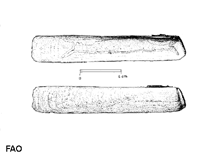
Bivalvia |
Adapedonta |
Solenidae
สิ่งแวดล้อม : สิ่งแวดล้อม / เขตภูมิอากาศ / ระดับความลึก / ระยะการกระจายสินค้า
นิเวศวิทยา
Benthic; ระดับความลึก 5 - 35 m (อ้างอิง 122905). Subtropical; 56°N - 16°S, 18°W - 36°E
Eastern Atlantic and the Mediterranean Sea.
ความยาวเมื่อครบกำหนดครั้งแรก / ขนาด / น้ำหนัก / อายุ
วัยเจริญพันธุ์: Lm 4.8 range ? - ? cm Max length : 17.0 cm SHL เพศผู้/กระเทย; (อ้างอิง 109255)
Maximum depth from Ref. 122906. Found in lagoons (Ref. 122905) and estuaries (Ref 122906). Lives buried in sand and/or muddy sand in low intertidal and subtidal zones (Ref. 122904). Found in fine well sorted sand (Ref. 2780). Associated with Zostera marina seagrass beds (Ref. 122906).
วงจรชีวิตและพฤติกรรมการผสมพันธุ์
วัยเจริญพันธุ์ | การสืบพันธุ์ | การวางไข่ | เซลสืบพันธ์ของเพศเมีย(ไข่) | ความดกของไข่ | ตัวอ่อน
Members of the class Bivalvia are mostly gonochoric, some are protandric hermaphrodites. Life cycle: Embryos develop into free-swimming trocophore larvae, succeeded by the bivalve veliger, resembling a miniature clam.
Gusso, C.C., M.F. Gravina and F.R. Maggiore 2001 Temporal variations in soft bottom benthic communities in central Tyrrhenian Sea (Italy). Archo Oceanogr. Limnol. 22:175-182. (อ้างอิง 2780)
สถานะบัญชีแดงของ IUCN
(อ้างอิง 130435: Version 2025-2 (Global))
สถานะไซเตส (อ้างอิง 108899)
Not Evaluated
CMS (อ้างอิง 116361)
Not Evaluated
ภัยคุกคามต่อมนุษย์
การใช้ของมนุษย์
การประมง: การค้า
| FishSource |
เครื่องมือ
ข้อมูลเพิ่มเติม
นิเวศวิทยาเขตร้อนรายการอาหาร (เหยื่อ)
องค์ประอบของอาหาร
การบริโภคอาหาร
ผู้ล่า
เกี่ยวข้องกับมนุษย์แสตมป์ เหรียญ อื่นๆ
แหล่งที่มาจากอินเตอร์เน็ต
การประมาณค่าตามแบบจำลอง
ความเสี่ยงต่อการตกปลา
Low vulnerability (10 of 100).