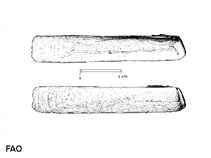
Bivalvia |
Adapedonta |
Solenidae
Milieu: milieu / Klimaatzone / Diepte / verspreidingsgebied
Ecologie
Benthic; diepte 5 - 35 m (Ref. 122905). Subtropical; 56°N - 16°S, 18°W - 36°E
Eastern Atlantic and the Mediterranean Sea.
Lengte bij maturiteit / Grootte / Gewicht / Leeftijd
Maturiteit: Lm 4.8 range ? - ? cm Max length : 17.0 cm SHL mannelijk / geslacht onbekend; (Ref. 109255)
Maximum depth from Ref. 122906. Found in lagoons (Ref. 122905) and estuaries (Ref 122906). Lives buried in sand and/or muddy sand in low intertidal and subtidal zones (Ref. 122904). Found in fine well sorted sand (Ref. 2780). Associated with Zostera marina seagrass beds (Ref. 122906).
Levenscyclus en paargedrag
Maturiteit | Voortplanting | Paaien | Eieren | Fecunditeit | Larven
Members of the class Bivalvia are mostly gonochoric, some are protandric hermaphrodites. Life cycle: Embryos develop into free-swimming trocophore larvae, succeeded by the bivalve veliger, resembling a miniature clam.
Gusso, C.C., M.F. Gravina and F.R. Maggiore 2001 Temporal variations in soft bottom benthic communities in central Tyrrhenian Sea (Italy). Archo Oceanogr. Limnol. 22:175-182. (Ref. 2780)
Status op de Rode Lijst van het IUCN
(Ref. 130435: Version 2025-2 (Global))
CITES status (Ref. 108899)
Not Evaluated
Not Evaluated
Gevaar voor de mens
Gebruik door de mens
Visserij: commercieel
| FishSource |
Tools
Meer informatie
Trofische ecologieVoedsel (prooien)
Dieetsamenstelling
Voedselconsumptie
Predatoren
FysiologieZuurstofverbruik
Menselijk gerelateerdPostzegels, munten, diversen.
Internetbronnen
Schattingen op basis van modellen
Kwetsbaarheid van de visserij
Low vulnerability (10 of 100).