Malacostraca |
Amphipoda |
Ampeliscidae
Meio ambiente: milieu / Zona climática / intervalo de profundidade / faixa de distribuição
Ecologia
Benthic; estuarina; intervalo de profundidade 7 - 9 m (Ref. 2851). Subtropical
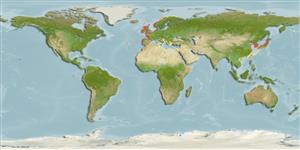
Western Pacific, Northeast Atlantic and the Mediterranean.
Comprimento de primeira maturação / Tamanho / Peso / Idade
Maturidade: Lm ? range ? - ? cmidade máx. registrada: 1.00 anos (Ref. 2823)
Depth based on occurrence (Ref. 2851, p. 719); to be replaced with better reference. Found in estuarine and inshore areas (Ref. 96352), and even marine caves (Ref. 96564). Inhabits sandy bottoms (Refs. 2780, 124788) of silt to fine sand (Ref. 96352). A microvore that feeds on organic detritus (Ref. 96352).
Ciclo de vida ou comportamento de acasalamento
Maturidade | Reprodução | Desova | Ovos | Fecundidade | Larvas
Members of the order Amphipoda are gonochoric and sexually dimoprhic (males larger than females). Mating behavior: Males locate potential partners with the aid of their antenna to detect the pheromones released by the females; the male then rides or carries the female until the latter is ready to molt. When the female is ready, the male pushes the sperm into the marsupium and releases the female afterwards. A few hours later, the female releases her eggs into the marsupium for fertilization. Life cycle: Eggs are brooded in the marsupium. Eggs hatch into juveniles and remain in the marsupium for a few days. Each species undergo 20 molts at most, i.e., 1-year long life cycle.
Alves, F., L. Chicharo, A. Nogueira and J. Regala 2003 Changes in benthic community structure due to clam dreging on the Algarve coast and the importance of seasonal analysis. J. Mar. Biol. Ass. U.K. 83:719-729. (Ref. 2851)
Status na Lista Vermelha da UICN
(Ref. 130435: Version 2025-2 (Global))
Status no CITES (Ref. 108899)
Not Evaluated
Not Evaluated
Ameaça para os humanos
Uso pelos humanos
| FishSource |
Ferramentas
Mais informação
Ciclo de vidaReproduçãoMaturidadeFecundidadeDesovaOvosDesenvolvimento dos ovosLarvas FisiologiaConsumo de oxigênio
Relacionado a humanosSelos, moedas, diversos.
Fontes da internet
Estimativas baseadas em modelos
Temperatura preferida
(Ref.
115969): 9.2 - 20.6, mean 12.5 (based on 673 cells).
Categoria de preço
Unknown.