Malacostraca |
Amphipoda |
Ampeliscidae
Περιβάλλον: περιβάλλον / κλιματική ζώνη / εύρος βάθους / εύρος διανομής
Οικολογία
Benthic; Υφάλμυρο; εύρος βάθους 7 - 9 m (Αναφ. 2851). Subtropical
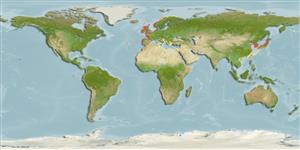
Western Pacific, Northeast Atlantic and the Mediterranean.
Μήκος κατά την πρώτη ωρίμανση / Μέγεθος / Βάρος / Ηλικία
Γεννητική Ωρίμανση: Lm ? range ? - ? cmμεγ. αναφερόμενη ηλικία: 1.00 έτη (Αναφ. 2823)
Depth based on occurrence (Ref. 2851, p. 719); to be replaced with better reference. Found in estuarine and inshore areas (Ref. 96352), and even marine caves (Ref. 96564). Inhabits sandy bottoms (Refs. 2780, 124788) of silt to fine sand (Ref. 96352). A microvore that feeds on organic detritus (Ref. 96352).
Κύκλος ζωής και συμπεριφορά ζευγαρώματος
Γεννητική Ωρίμανση | Αναπαραγωγή | Γεννοβολία | Αβγά | Γονιμότητα | Προνύμφες
Members of the order Amphipoda are gonochoric and sexually dimoprhic (males larger than females). Mating behavior: Males locate potential partners with the aid of their antenna to detect the pheromones released by the females; the male then rides or carries the female until the latter is ready to molt. When the female is ready, the male pushes the sperm into the marsupium and releases the female afterwards. A few hours later, the female releases her eggs into the marsupium for fertilization. Life cycle: Eggs are brooded in the marsupium. Eggs hatch into juveniles and remain in the marsupium for a few days. Each species undergo 20 molts at most, i.e., 1-year long life cycle.
Alves, F., L. Chicharo, A. Nogueira and J. Regala 2003 Changes in benthic community structure due to clam dreging on the Algarve coast and the importance of seasonal analysis. J. Mar. Biol. Ass. U.K. 83:719-729. (Αναφ. 2851)
Κατάσταση Κόκκινου Καταλόγου IUCN
(Αναφ. 130435: Version 2025-2 (Global))
Καθεστώς CITES (Αναφ. 108899)
Not Evaluated
Not Evaluated
Απειλή για τον άνθρωπο
Ανθρώπινες χρήσεις
| FishSource |
Εργαλεία
Περισσότερες πληροφορίες
Κύκλος ζωήςΑναπαραγωγήΓεννητική ΩρίμανσηΓονιμότηταΓεννοβολίαΑβγάΑνάπτυξη αυγώνΠρονύμφες ΦυσιολογίαΚατανάλωση οξυγόνου
Ανθρώπινη σχέσηΓραμματόσημα, νομίσματα, διάφορα.
Διαδικτυακές πηγές
Εκτιμήσεις βάσει μοντέλων
Προτιμώμενη θερμοκρασία
(Ref.
115969): 9.2 - 20.6, mean 12.5 (based on 673 cells).
Κατηγορία τιμής
Unknown.