Hexacorallia |
Scleractinia |
Caryophylliidae
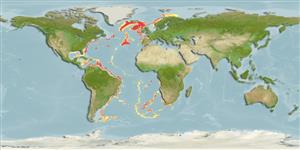
Umwelt: Milieu / Klimazone / Tiefenbereich / Verbreitungsgebiet
Ökologie
Sessile; tiefenbereich 274 - 2288 m (Ref. 78567). Subtropical
Atlantic Ocean.
Länge bei der ersten Reifung / Größe / Gewicht / Alter
Geschlechtsreife: Lm ? range ? - ? cm Max length : 3.0 cm H Männchen/unbestimmt; (Ref. 78567); common length : 2.0 cm H Männchen/unbestimmt; (Ref. 78567)
Depth range from records in Ref. 78567, height measurement not allowing for the curve.
Lebenszyklus und Paarungsverhalten
Geschlechtsreife | Fortpflanzung | Ablaichen | Eier | Fruchtbarkeit | Larven
Members of the class Anthozoa are either gonochoric or hermaphroditic. Mature gametes are shed into the coelenteron and spawned through the mouth. Life cycle: The zygote develops into a planktonic planula larva. Metamorphosis begins with early morphogenesis of tentacles, septa and pharynx before larval settlement on the aboral end.
Moseley, H.N. 1881 Report on certain hydroid, alcyonarian, and madreporarian corals procured during the voyage of H.M.S. Challenger. In Report of the scientific results of the voyage of H.M.S. Challenger during the years 1873-76: a summary of the scientific results, Zoology 2:1-248. (Ref. 78567)
IUCN Rote Liste Status
(Ref. 130435: Version 2025-2 (Global))
CITES Status (Ref. 108899)
Not Evaluated
Not Evaluated
Bedrohung für Menschen
Harmless
Nutzung durch Menschen
| FishSource |
Tools
Mehr Information
Trophische ÖkologieLebensmittel (Beutetiere)
Nahrungszusammensetzung
Nahrungsaufnahme
Räuber
PopulationsdynamikWachstum
Max. Alter/Größen
Länge-Gewicht-Rel.
Länge-Länge-Verhältnis.
Längenhäufigkeiten
Massenkonvertierung
Dichte
LebenszyklusFortpflanzungGeschlechtsreifeFruchtbarkeitAblaichenEierEientwicklungLarven PhysiologieSauerstoffverbrauch
MenschenbezogenBriefmarken, Münzen, Verschiedenes.
Internet Quellen
Schätzungen auf der Grundlage von Modellen
Bevorzugte Temperatur
(Ref.
115969): 1.8 - 4.6, mean 3.7 (based on 59 cells).
Anfälligkeit der Fischerei
Low vulnerability (10 of 100).