Cephalopoda |
Octopoda |
Eledonidae | Eledoninae
สิ่งแวดล้อม : สิ่งแวดล้อม / เขตภูมิอากาศ / ระดับความลึก / ระยะการกระจายสินค้า
นิเวศวิทยา
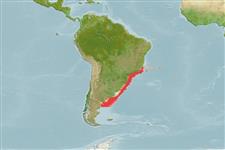
Benthic; ระดับความลึก 30 - 300 m (อ้างอิง 96968). Subtropical; 20°S - 44°S, 65°W - 28°W (อ้างอิง 107072)
Southwest Atlantic: Brazil to Argentina.
ความยาวเมื่อครบกำหนดครั้งแรก / ขนาด / น้ำหนัก / อายุ
วัยเจริญพันธุ์: Lm ? range ? - ? cm Max length : 9.0 cm ML เพศผู้/กระเทย; (อ้างอิง 105659); อายุสูงสุดที่ได้รายงาน: 2.00 ปี (อ้างอิง 104514)
Frequently caught in bottom trawls together with Eledone gaucha Haimovici, 1988 (Ref. 104514). Benthic (Ref. 104514). Coexists with Eledone gaucha along the continental shelf and slope. Inhabits soft bottoms, on both sandy and muddy bottoms. Feeds mainly on crustaceans such as crabs and stomatopods (Ref. 104173).
Mating behavior: Males perform various displays to attract potential females for copulation. During copulation, male grasp the female and inserts the hectocotylus into the female's mantle cavity where fertilization usually occurs. Life cycle: Embryos hatch into planktonic stage and live for some time before they grow larger and take up a benthic existence as adults (Ref. 833). Eggs are attached on a hard substrate. Females die after releasing the hatchlings (Ref. 104514).
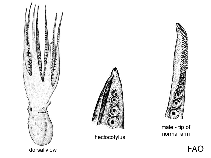
Roper, C.F.E., M.J. Sweeney and C.E. Nauen 1984 FAO Species Catalogue. Vol. 3. Cephalopods of the world. An annotated and illustrated catalogue of species of interest to fisheries. FAO Fish. Synop. 125(3):277p. Rome: FAO. (อ้างอิง 275)
สถานะบัญชีแดงของ IUCN
(อ้างอิง 130435: Version 2025-2 (Global))
สถานะไซเตส (อ้างอิง 108899)
Not Evaluated
CMS (อ้างอิง 116361)
Not Evaluated
ภัยคุกคามต่อมนุษย์
การใช้ของมนุษย์
การประมง: การค้า
| FishSource |
เครื่องมือ
ข้อมูลเพิ่มเติม
พลวัตของประชากรการเจริญเติบโตอายุสูงสุด / ขนาดความยาว-น้ำหนักสัมพันธ์ความยาว-ความยาวสัมพันธ์ความยาว-ความถี่การแปลงมวลอุดมสมบรูณ์ เกี่ยวข้องกับมนุษย์แสตมป์ เหรียญ อื่นๆ
แหล่งที่มาจากอินเตอร์เน็ต
การประมาณค่าตามแบบจำลอง
อุณหภูมิที่ต้องการ
(Ref.
115969): 7.7 - 21.7, mean 13.7 (based on 74 cells).
ความเสี่ยงต่อการตกปลา
Low vulnerability (10 of 100).