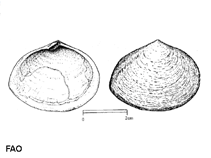
Bivalvia |
Cardiida |
Semelidae
Milieu: milieu / Klimaatzone / Diepte / verspreidingsgebied
Ecologie
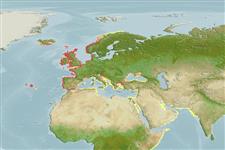
Benthic; diepte 7 - 9 m (Ref. 2851). Subtropical, preferred 8°C (Ref. 107945); 69°N - 12°N, 18°W - 60°E
Western Indian Ocean, Northeast Atlantic and the Mediterranean.
Lengte bij maturiteit / Grootte / Gewicht / Leeftijd
Maturiteit: Lm ?, range 2 - ? cm Max length : 6.5 cm SHL mannelijk / geslacht onbekend; (Ref. 109255); max. gerapporteerde leeftijd: 18 Jaren (Ref. 101483)
Depth based on occurrence (Ref. 2851, p. 719); to be replaced with better reference. Found in intertidal mudflats (Ref. 2823).
Levenscyclus en paargedrag
Maturiteit | Voortplanting | Paaien | Eieren | Fecunditeit | Larven
Members of the class Bivalvia are mostly gonochoric, some are protandric hermaphrodites. Life cycle: Embryos develop into free-swimming trocophore larvae, succeeded by the bivalve veliger, resembling a miniature clam (Ref. 833).
Alves, F., L. Chicharo, A. Nogueira and J. Regala 2003 Changes in benthic community structure due to clam dreging on the Algarve coast and the importance of seasonal analysis. J. Mar. Biol. Ass. U.K. 83:719-729. (Ref. 2851)
Status op de Rode Lijst van het IUCN
(Ref. 130435: Version 2025-2 (Global))
CITES status (Ref. 108899)
Not Evaluated
Not Evaluated
Gevaar voor de mens
Gebruik door de mens
Visserij: commercieel
| FishSource | Sea Around Us
Tools
Meer informatie
FysiologieZuurstofverbruik
Menselijk gerelateerdPostzegels, munten, diversen.
Internetbronnen
Schattingen op basis van modellen
Gewenste temperatuur
(Ref.
115969): 8.2 - 18.8, mean 11.3 (based on 569 cells).
Weerstandsvermogen
Hoog, minimale populatieverdubbelingstijd minder dan 15 maanden (K=0.2-0.51; tm=2.5; tmax=18).
Kwetsbaarheid van de visserij
Moderate vulnerability (39 of 100).
Kwetsbaarheid voor het klimaat
High vulnerability (58 of 100).
Prijsklasse
Unknown.
Nutrients : Calcium = 149 [71, 228] mg/100g; Iron = 8.53 [1.95, 15.11] mg/100g; Protein = 9.88 [8.64, 11.12] %; Omega3 = 0.313 [0.202, 0.423] g/100g; Selenium = 61 [50, 72] μg/100g; VitaminA = 0 μg/100g; Zinc = 2.04 [0.56, 3.51] mg/100g (wet weight); based on
nutrient studies.