Hexacorallia |
Actiniaria |
Hormathiidae
Environnement : milieu / zone climatique / profondeur / gamme de distribution
Écologie
Sessile. Subtropical
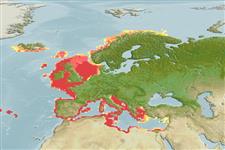
Atlantic and the Mediterranean.
Longueur à la première maturité / Taille / Poids / Âge
Maturité: Lm ? range ? - ? cm
Description synthétique
Morphologie
Column Size: 8 to 10 cm in height. Column: robust and cylindrical. Color: whitish or yellowish, with a dozen broad longitudinal brown scratches. Tentacles: 3 cm long; yellow gray, slightly transparent; they are numerous. Aconties: long irritant purple filaments; projected with each shock or contact (Ref. 364).
Column Size: 8 to 10 cm in height. Fishing is done artisanalement, with the dredger. Consumed primarily in Sicily. The species meets on all the Mediterranean circumference between a few meters and a hundred meters, on sandy-muddy or detrital substrates (Ref. 364). Known from infra- and circalittoral as well as bathyal zones (Ref. 85338). Solitary (Ref. 2377).
Cycle de vie et comportement reproducteur
Maturité | Reproduction | Frai | Œufs | Fécondité | Larves
Members of the class Anthozoa are either gonochoric or hermaphroditic. Mature gametes are shed into the coelenteron and spawned through the mouth. Life cycle: The zygote develops into a planktonic planula larva. Metamorphosis begins with early morphogenesis of tentacles, septa and pharynx before larval settlement on the aboral end.
Carpine, C. 1987 Cnidairies (Meduses, Actinies et Coraux). p. 147 - 166. In Fischer, W., M. L. Bauchot and M. Schneider. 1987. Fiches FAO d' identification des espèces pour les besoins de la pêche. (Revision 1). Méditerranée et mer Noire. Zone de pêche 37. Volume I. Végëtaux et Invertébrés. Publication préparée par la FAO, résultant d'un accord entre la FAO et la Commission des Communautés européennes (Project GCP/INT/422/EEC) financëe conjointement par ces deux organisations. Rome, FAO, Vol.1. (Réf. 364)
Statut dans la liste rouge de l'IUCN
(Réf. 130435: Version 2025-2 (Global))
statut CITES (Réf. 108899)
Not Evaluated
Not Evaluated
Menace pour l'homme
Utilisations par l'homme
| FishSource |
Outils
Plus d'informations
Écologie trophiqueAliments (proies)
Composition du régime alimentaire
Consommation alimentaire
Prédateurs
Dynamique des populationsCroissance
Âges / tailles maximales
Longueur-poids rel.
Rel. longueur-longueur.
Fréquences de longueurs
Conversion de masse
Abondance
Cycle de vieReproductionMaturitéFéconditéFraiŒufsDéveloppement de l'œufLarves PhysiologieConsommation d'oxygène
Liées à l'hommeTimbres, pièces de monnaie, divers
Sources Internet
Estimations basées sur des modèles
Température préférée
(Ref.
115969): 7 - 15.7, mean 10.2 (based on 332 cells).
Catégorie de prix
Unknown.