Echinoidea |
Camarodonta |
Toxopneustidae
Environnement : milieu / zone climatique / profondeur / gamme de distribution
Écologie
Benthic; profondeur 0 - 55 m (Réf. 83942). Tropical
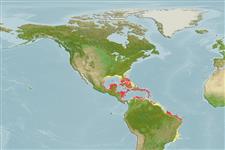
Atlantic Ocean: throughout the Caribbean and western Africa.
Longueur à la première maturité / Taille / Poids / Âge
Maturité: Lm ? range ? - ? cm
This is an epibenthic, subtidal species (Ref. 83942), found on Thalassia sp. beds (Ref. 86574).
Cycle de vie et comportement reproducteur
Maturité | Reproduction | Frai | Œufs | Fécondité | Larves
Members of the class Echinoidea are gonochoric. Fertilization is external. Brooding is common, eggs are held either on the peristome, around the periproct or deep into the concavities on the petaloids. Life cycle: Embryos develop into planktotrophic larvae (echinoplateus) and live for several months before they sink to the bottom using their tube feet to adhere on the ground where they metamorphose into young urchins.
Collin, R., M.C. Díaz, J. Norenburg, R.M. Rocha, J.A. Sánchez, M. Schulze, A. Schwartz and A. Valdés 2005 Photographic identification guide to some common marine invertebrates of Bocas Del Toro, Panama. Caribbean Journal of Science. 41(3):638-707. (Réf. 415)
Statut dans la liste rouge de l'IUCN
(Réf. 130435: Version 2025-2 (Global))
statut CITES (Réf. 108899)
Not Evaluated
Not Evaluated
Menace pour l'homme
Utilisations par l'homme
| FIRMS (Stock assessments) | FishSource |
Outils
Plus d'informations
Dynamique des populationsCroissanceÂges / tailles maximalesLongueur-poids rel.Rel. longueur-longueur.Fréquences de longueursConversion de masseAbondance Cycle de vieReproductionMaturitéFéconditéFraiŒufsDéveloppement de l'œufLarves PhysiologieConsommation d'oxygène
Liées à l'hommeTimbres, pièces de monnaie, divers
Sources Internet
Estimations basées sur des modèles
Température préférée
(Ref.
115969): 25.5 - 28, mean 27.3 (based on 190 cells).
Résilience
Haut, temps minimum de doublement de population inférieur à 15 mois (K=0.84).
Catégorie de prix
Unknown.